
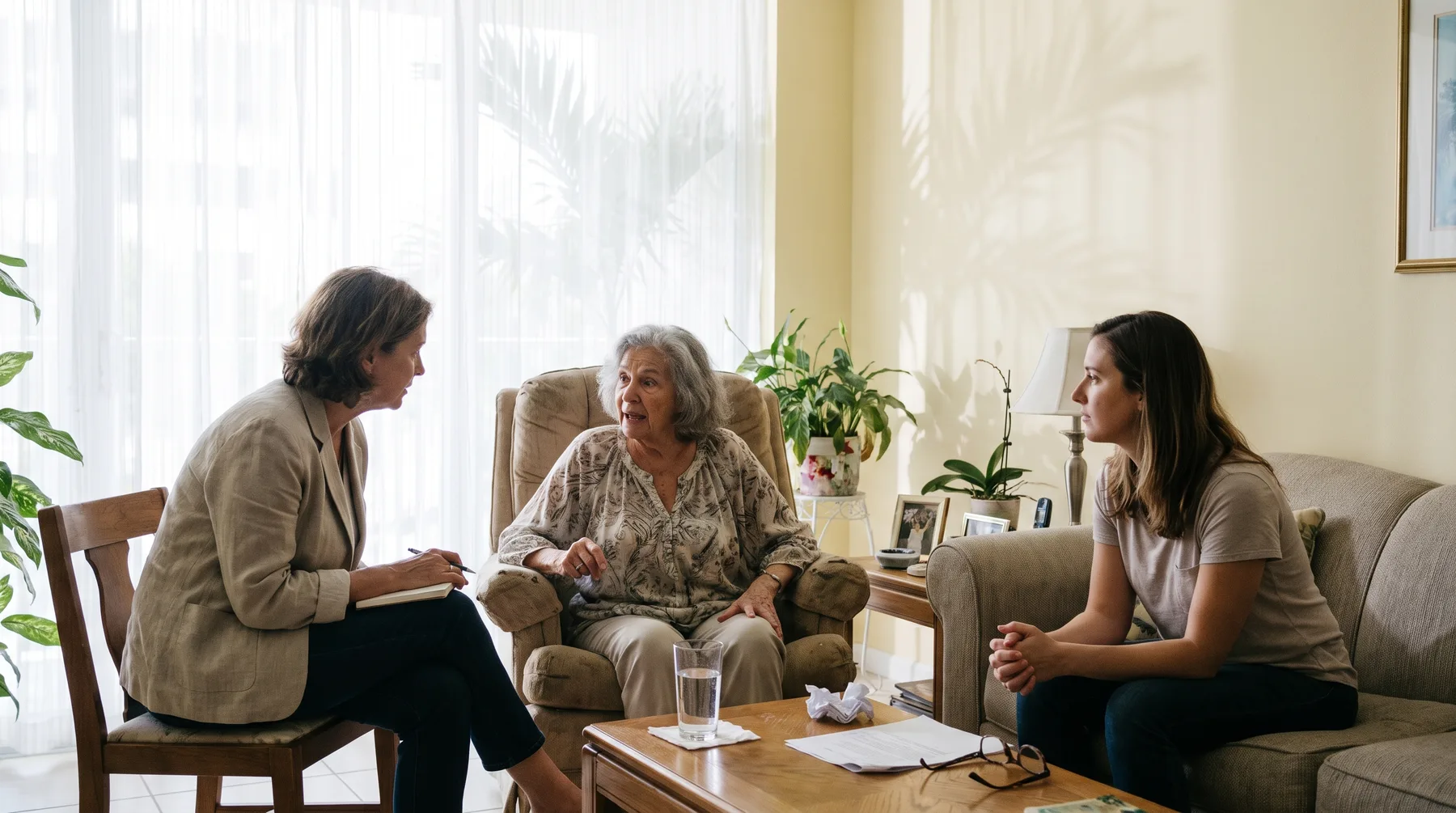
What happens at the visit
A registered nurse comes to the home and sits down with both of you. She watches how your parent moves. She listens to what the day looks like. She checks the rooms your parent uses most. The visit takes about an hour.
She is not there to treat anything. She is there to see the whole picture and write a plan. You keep that plan, whether you hire allaround or not.
Have these ready before the nurse arrives
None of this is required. Bring what you can find. A few items on the kitchen table is enough.
- A list of every medication, including over-the-counter
- The name and number of the primary doctor
- Any recent hospital or ER paperwork
- Glasses, hearing aids, cane, or walker in reach
- A list of falls or close calls in the last few months
- Notes on what your parent still does well
- Names of anyone else who helps, and how often
- Your questions, written down so you do not forget
How the visit goes, step by step
Introductions and the real reason you called
The nurse sits with you and your parent. She asks what changed, what scared you, and what a normal day looks like now.
A walk through the home
She looks at the bathroom, the bedroom, the kitchen, and the path between them. She notes trip hazards, lighting, grab bars, and stairs.
A look at how your parent moves and manages
She watches small things. Standing up from the chair without using hands. The walk from the bed to the bathroom. Turning around in a tight space. She asks about bathing, dressing, meals, memory, and sleep.
A conversation about medications and doctors
She reviews the medication list for gaps or confusion. She does not change anything. Clinical questions go back to the doctor.
A written care plan you keep
Before she leaves, she goes over what she saw and what she recommends. You get the plan in writing. You are free to use it here or take it anywhere else.
What the RN does and does not do
| The RN at the assessment(what we do) | Not part of this visit |
|---|---|
| Observes safety and daily function | Diagnosing anything |
| Reviews your medication list | Changing or prescribing medications |
| Writes a plain-English care plan | Ordering tests or treatments |
| Answers questions about non-medical care | Wound care, injections, or therapy |
| Refers you back to the doctor when needed | Replacing your parent's physician |
For anything clinical, the doctor stays in charge. Home health, if ordered, can run alongside non-medical care.
If tonight feels urgent
An assessment visit is not an emergency service. Call 911 or the doctor tonight if your parent has chest pain, sudden one-sided weakness, new fast-onset confusion, trouble breathing, or a bad fall. When in doubt, call.
What you walk away with
You end the visit with a written care plan, a clearer read on the risks in the home, and a list of what help would actually look like. That is yours to keep.
If you want to start care, the same nurse stays involved and matches a caregiver to your parent. If you do not, the plan is still useful the next time a doctor or a sibling asks what is going on.
Common questions
How soon can a nurse come to the house?
Usually within 24 hours of your call. If you call late at night, expect a callback first thing in the morning to set a time. The nurse works around your parent's schedule, not the other way around.
Does my parent have to agree to the visit?
Yes, and it helps if the visit is framed as a conversation, not a decision. Tell your parent a nurse is coming by to talk, look at the house, and answer questions. Most parents relax once they see the nurse is not there to move them out.
What if I cannot be there in person?
You can join by phone or video while the nurse is at the house. Many adult children live in another state and do it this way. The written plan comes to you afterward.
Will the nurse pressure us to sign something that day?
No. The assessment is free and there is no obligation to book care. You get the written plan either way, and you can take it to another agency if you prefer.
Can the caregiver speak Spanish?
Yes. Many of the caregivers are bilingual in English and Spanish, and the nurse will match your parent with someone who fits. Tell the nurse at the visit which language your parent is most comfortable in.
What does this cost?
The RN assessment is free. Ongoing care depends on how many hours you need and what level of help your parent requires. The nurse will walk you through the options in plain terms during the visit. You are not asked to commit that day.