
Start with the power question, not the go-bag
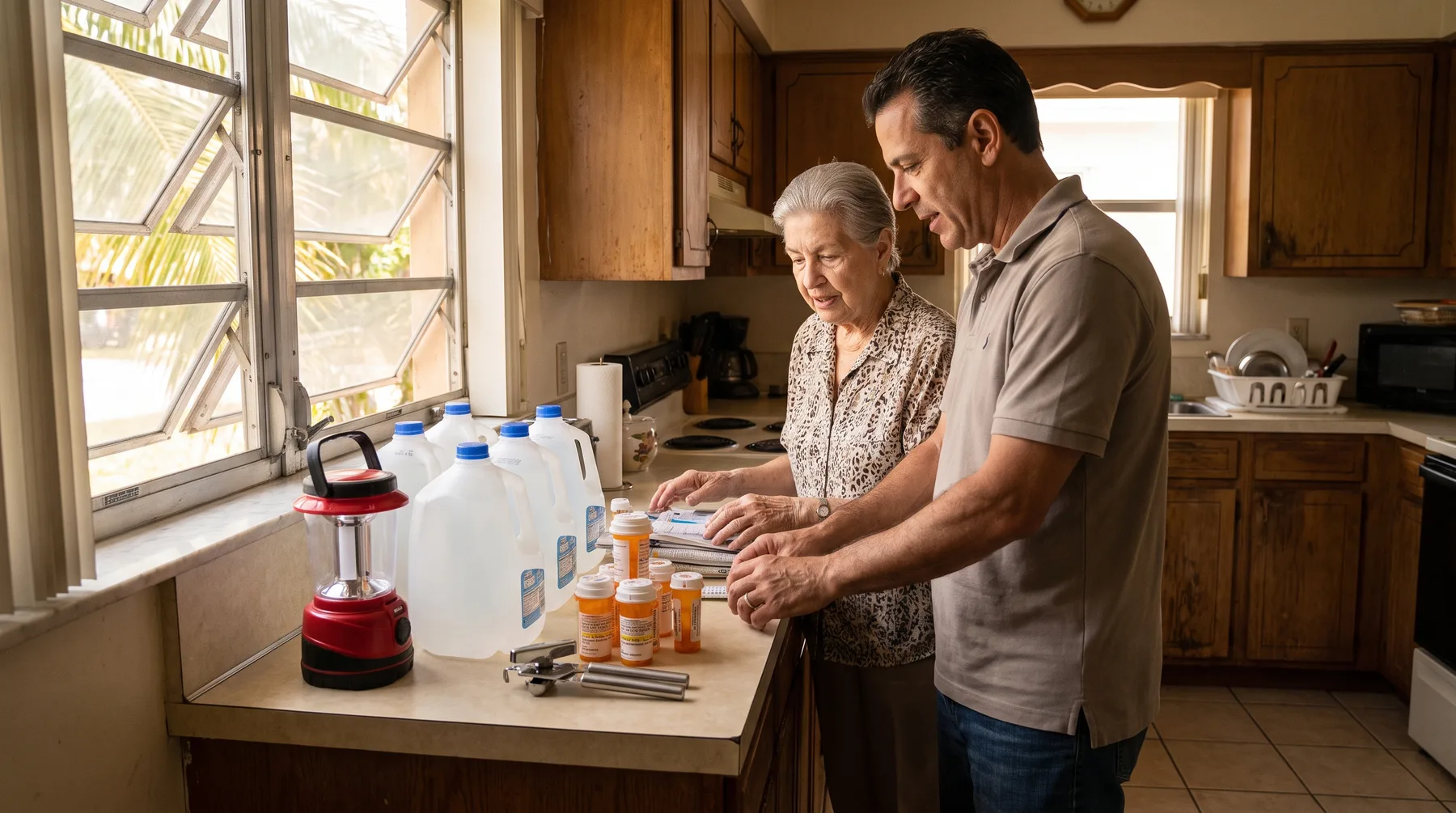
Call the power company today and register your parent as a special-needs customer, then call their doctor's office for a paper list of every medication with doses. Do those two calls before you pack a single bottle of water. Power restoration priority and a printed med list are what turn a bad three days into a manageable three days.
Everything else here assumes you have made those two calls. If your parent uses oxygen, a CPAP, a stairlift, a power wheelchair, or a medication that needs refrigeration, that special-needs registry line is the difference between waiting and being on a list. Miami-Dade and Monroe also run their own county emergency special-needs registries, which are separate from the utility list, so sign your parent up on the county site tonight (it takes about ten minutes).
What to put in the house this week
Not a generic hurricane kit. The things older adults specifically run out of or lose access to.
- Two weeks of every prescription, in original bottles, refilled early
- Printed medication list with doses, pharmacy, and prescribing doctor
- Paper copies of insurance cards, ID, and the doctor's after-hours number
- A cooler and ice packs for any medication that needs refrigeration
- Manual can opener and food that does not need cooking or hard chewing
- One gallon of water per person per day, for at least seven days
- Battery lantern in every room your parent uses, not candles
- Extra hearing aid batteries, denture supplies, glasses, incontinence products
- A hand fan and a spray bottle, for when the AC is out and it is 90 degrees
- Cash in small bills, because card readers go down
- Phone chargers plus one power bank, charged now
- A written list of who is checking in, on what day, by what method
The three days before landfall
Do these in order. Do not skip ahead because the forecast looks mild.
Confirm the shelter decision on paper
Ask your parent directly whether they are staying or going, and write down what they said and when. If they are staying, that is their choice to make. Your job shifts to making staying as safe as it can be.
Fill every prescription and the gas tank
Pharmacies and gas stations empty out fast once a watch is issued. Call the pharmacy and ask for an early refill under the emergency rule Florida allows during a declared storm. Fill the car even if your parent is not evacuating, because you may need to reach them.
Do a walk-through of the house
Move anything they use daily to one floor and away from windows. Clear the path from bed to bathroom to kitchen. Put the lantern, phone, glasses, and a bottle of water on the nightstand. Bring in or tie down anything on the balcony or patio.
Set the check-in schedule and the fallback
Pick who calls at what time each day, and what happens if they cannot reach your parent. Name one neighbor who can physically knock on the door. Share the plan with your parent so no one is surprised.
Decide the leave trigger in advance
Write down the specific thing that means your parent goes to a shelter or to family: a mandatory evacuation order for their zone, loss of power lasting more than a set number of hours, or any medical change. Deciding this while it is calm is easier than deciding it at 2am in the wind.
When staying home is reasonable, and when it is not
A quick read on the situations that change the math.
| Situation | Staying home is reasonable | Time to leave |
|---|---|---|
| Evacuation zone | Not in a mandatory zone | Zone A, B, or any mandatory order |
| Home type | Solid single-family, shutters up, not in a flood area | Mobile home, ground floor near water, high-rise above the tenth floor |
| Power dependence | No powered medical equipment | Oxygen, dialysis, refrigerated medication, power wheelchair |
| Mobility | Can move to a safe interior room without help | Bed-bound or needs two people to transfer |
| Support in place | Family or caregiver can reach the home | No one can get there for at least a day |
If any row in the right column applies, plan to leave. Do not weigh it against the left column. High floors matter because elevators fail and water pressure drops, which strands anyone who cannot manage many flights of stairs.
The real danger after a Miami storm is heat, not wind
Most storm-related deaths in older adults here happen after landfall, when the power is out and the house climbs past 90 degrees. If the AC has been off for more than a day and your parent is not sweating, is confused, or has stopped drinking water, that is a 911 call. Also watch for dizziness, a flushed face, a rapid pulse, a headache that will not lift, or skin that is hot and dry to the touch. Do not wait for someone to check in.
Where a caregiver fits in
- Staying in the home before, during, and after the storm
- Cooking on a camp stove and managing food safely without power
- Helping with bathing when the water pressure is low
- Walking with your parent to the bathroom in the dark
- Making sure medications are taken on the usual schedule
- Driving to a shelter or to family if the plan changes
- Being the person on the ground when you are stuck out of town
What we set up on our end
A registered nurse comes to the home for a free assessment, generally within 24 hours of your call, and writes a care plan you keep whether or not you book care. The plan names the specific things your parent needs help with, and what a caregiver will and will not do.
Caregivers are W-2 employees, many bilingual in English and Spanish, and a live nurse is reachable 24/7 during the storm. If the caregiver sees something that needs a doctor, the nurse makes that call with you.
Common questions
My parent refuses to evacuate. What do I actually do?
You cannot force an adult to leave their home, and trying usually makes them dig in harder. Write down that you asked and what they said, then shift to making the stay safer: shutters, supplies, a caregiver in the house, and a clear check-in schedule. If a mandatory evacuation order comes for their zone, call it in to the county so first responders know the address.
How do I get medications refilled early before a storm?
Once the governor declares a state of emergency, Florida law lets pharmacies dispense an early refill of most prescriptions, often up to a 30-day supply, even if insurance would normally block it. Call the pharmacy directly and ask for the emergency refill. Do this the day the declaration happens, not the day before landfall.
What if the power is out for days and my parent has dementia?
Heat, darkness, and a broken routine make dementia symptoms much worse, fast. If the AC has been off for a day, or the confusion is noticeably worse, get your parent somewhere cool, whether that is a family member's house, a hotel with power, or a special-needs shelter. Bring their medication list, a familiar blanket, and something they usually eat.
Can a caregiver stay in the house during the storm?
Yes. Overnight and around-the-clock coverage during a storm is one of the more common requests we get from June through November. The nurse assessment covers what hours make sense, whether that is just the night of landfall or the full stretch from the watch through power restoration.
We live out of state. How do we even start from here?
Call, and a registered nurse will go to the home for a free in-person assessment, generally within 24 hours. You can join by phone or video. You get a written care plan afterward with no obligation to book. If you do book, you have 24/7 access to a live nurse.
Is this different from home health?
Yes. Home health is skilled medical care ordered by a doctor, usually after a hospital stay, and covers things like wound care and physical therapy. What we do is non-medical: bathing, meals, medication reminders, mobility help, rides, and company. Many families use both at the same time, and that is fine.